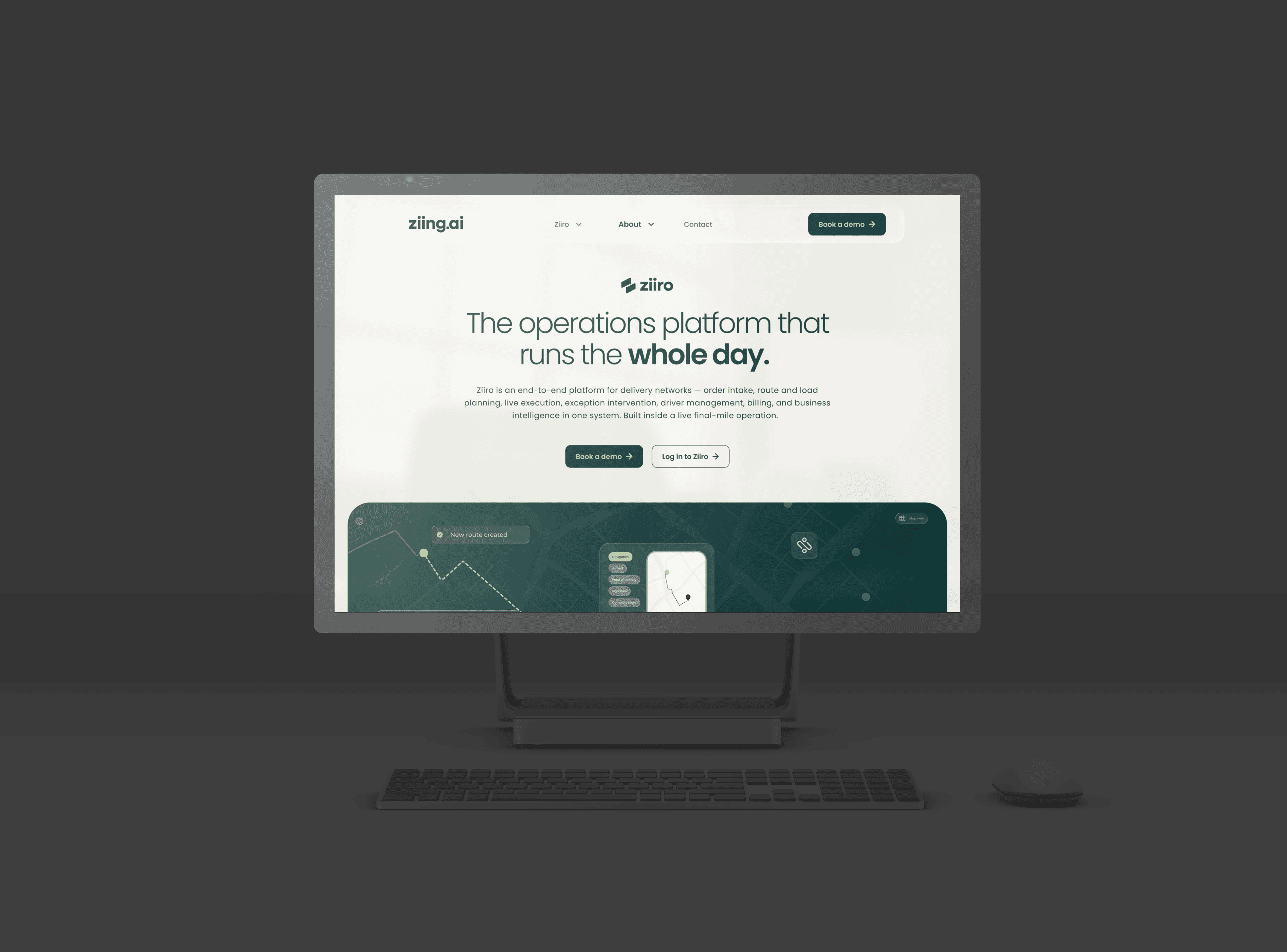
Ziing.ai
An intelligent, AI-driven delivery app redesigning logistics for speed, clarity, and simplicity.
Year:
2023 -2026
Timeframe:
2 years
Role:
Product designer
Category:
Mobile

Project overview
Ziing.ai set out to build something ambitious: a single, AI-powered platform that could run the entire dispatch-to-doorstep journey — matching, routing, tracking, and communication — for delivery operations at scale. At the center of that system sits the people who actually make it real: the drivers. The Driver App was never just a screen for accepting jobs. It was the thin, unglamorous layer between an intelligent backend and a person sitting in a truck at 6 a.m. with forty stops ahead of them. If that layer failed, the intelligence behind it didn\'t matter — the driver would fall back on habit, guesswork, or whatever app got them home fastest. Our job was to make sure it didn\'t fail.

Challenge
Rather than a rigid linear process, we used a rapid loop—understand, reframe, design, prove, repeat—to keep pace with constantly shifting operational realities.
Chaotic routing and navigation were eating time and attention that drivers didn't have to spare. Every extra tap, every unclear instruction, every moment of "wait, which stop is this?" had a real cost — measured in fatigue, missed windows, and frustration that landed on the customer at the door.
The daily load was heavy, literally and figuratively. Drivers weren't managing three or four tasks; they were managing dozens, back to back, under time pressure, often one-handed, often outdoors, often distracted. An interface that assumed calm, focused attention was an interface designed for the wrong context entirely.
Onboarding had to carry its own weight. Ziing needed drivers to self-onboard — start and finish their first real shift — with no in-person training and no safety net of a manager walking them through it. If the first fifteen minutes confused someone, we didn't get a second impression; we got a driver who went back to the old app and told three coworkers to do the same.
The real challenge wasn't "design a better delivery app." It was: earn adoption from a workforce with every incentive to stick with what already works, inside a product that also has to prove out an entire AI-driven dispatch model behind the scenes.

Approach
Rather than a rigid linear process, I used a rapid loop—understand, reframe, design, prove, repeat—to keep pace with constantly shifting operational realities.
Understanding the driver's day, not just the driver's task
Most task flows in delivery software are designed around the job: accept, navigate, deliver, confirm. I wanted to understand the shift — the thing that actually determines whether a tool survives contact with reality. That meant going past feature requests and into the texture of the work: what a driver does with their phone when their hands are full, how they behave under time pressure, where they improvise around a tool rather than with it, and what "efficient" actually means to someone being measured on stops-per-hour rather than clicks-per-flow.
The reframe
The insight that reshaped the project wasn't about navigation UI at all. It was that every screen in the app was competing against a mental model the driver already trusted — one built from months or years on the old tool. Any friction we introduced wasn't judged against "is this good design?" It was judged against "is this faster than what I already know?" That reframing changed what "simple" meant for this product. Simple didn't mean fewer features. It meant nothing new to learn in the moments that mattered most — starting a shift, finding the next stop, confirming a delivery, and handling the inevitable exception (wrong address, customer unavailable, missing parcels...)

Solution
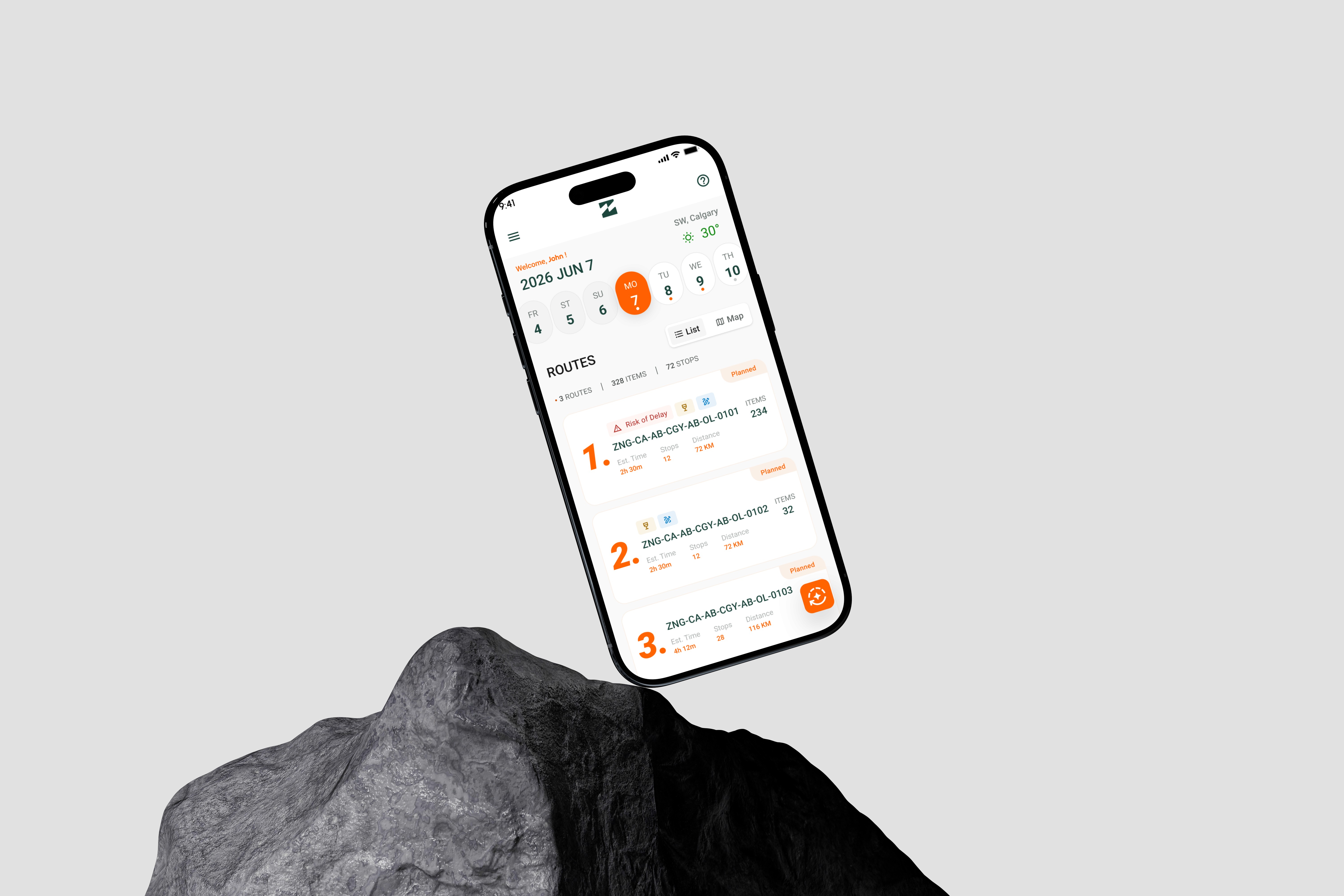
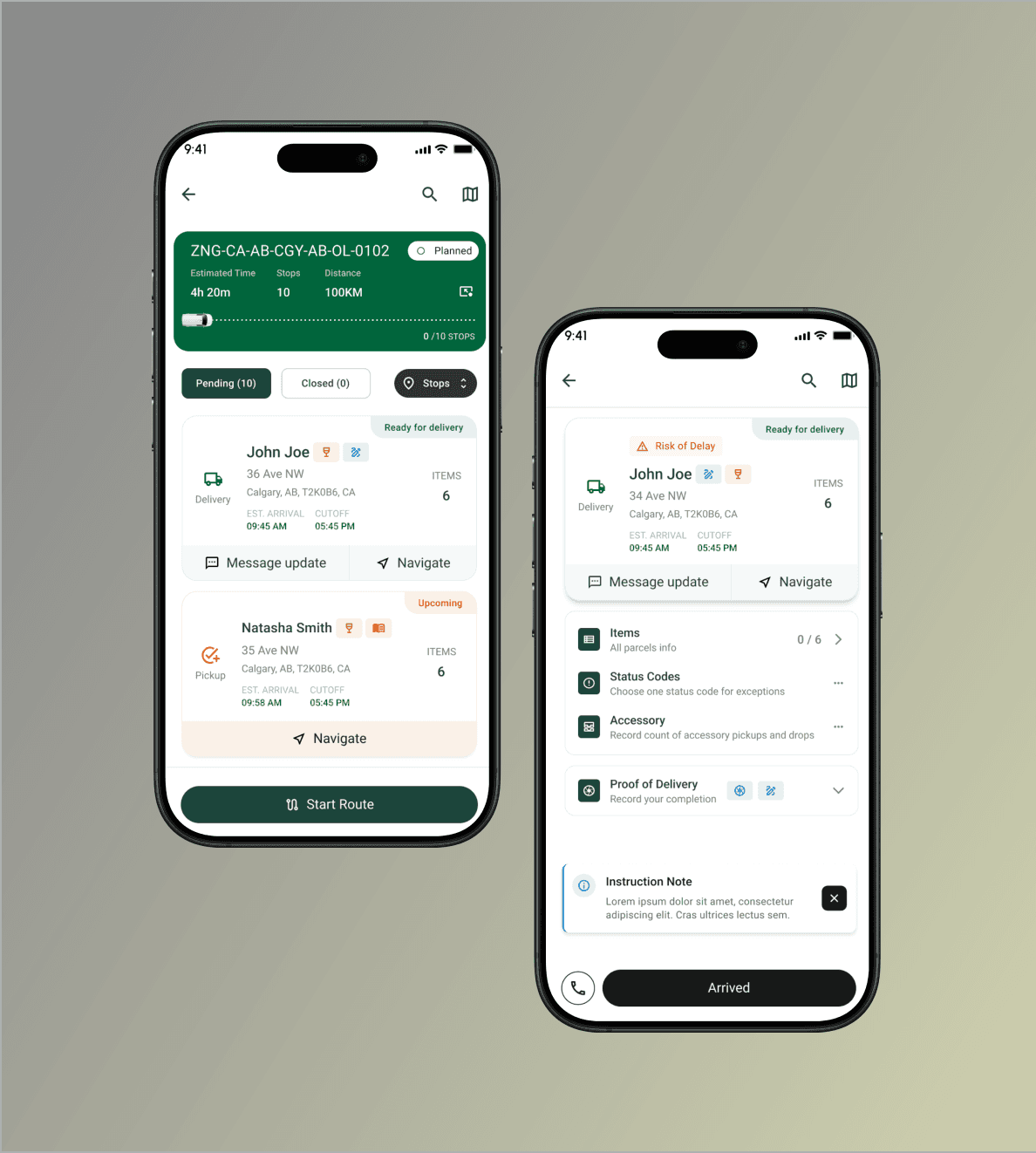
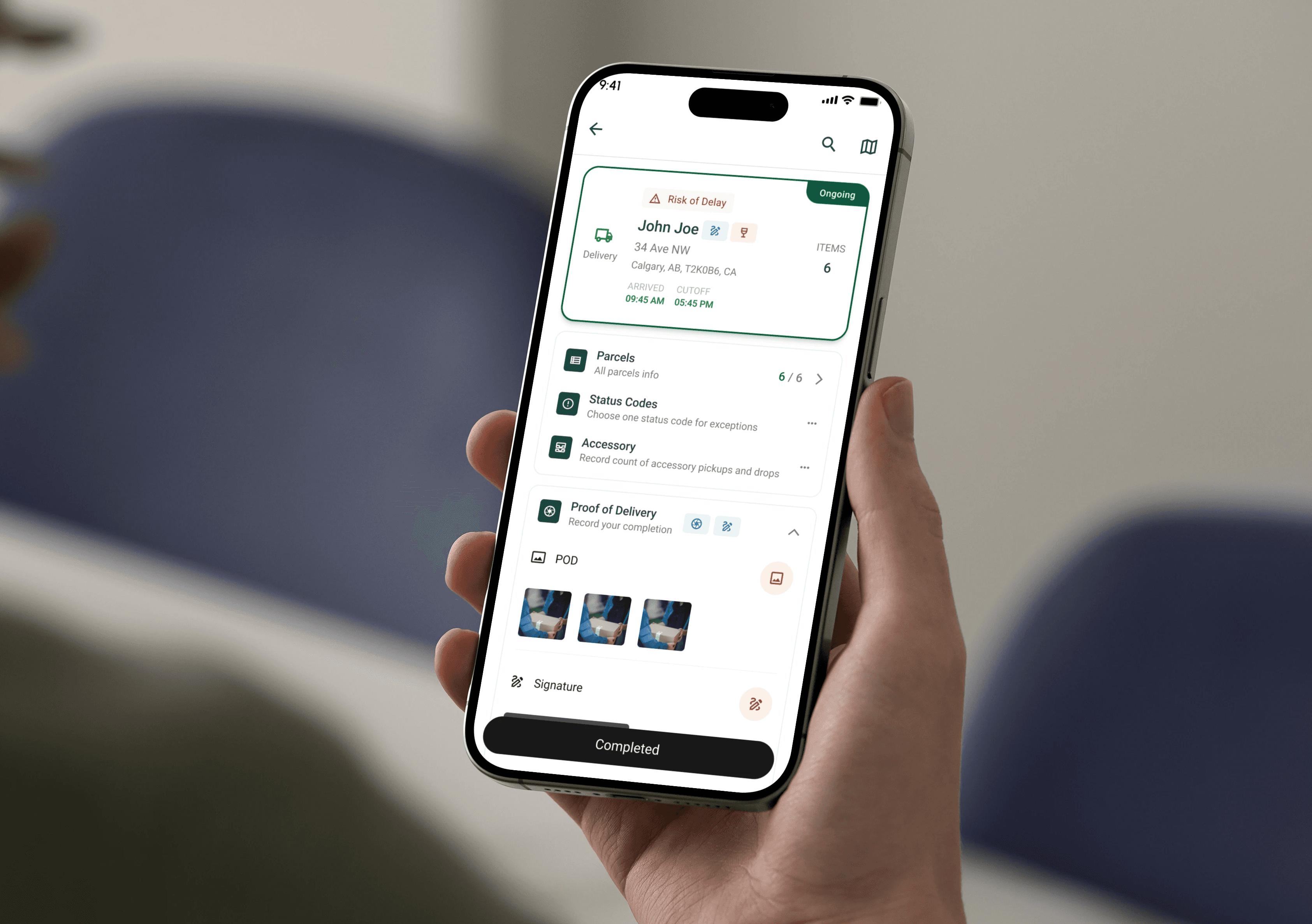
Self-onboarding. Rather than a generic account setup, onboarding was designed as the driver's first "shift" — a guided but low-stakes walkthrough that got them to a real, completed action as fast as possible, with in-context help replacing upfront explanation. Simplified, AI-assisted routing and navigation. Instead of surfacing the complexity of the underlying routing engine, the interface was designed to answer one question at a time — where do I go next — while quietly re-sequencing in the background as conditions changed. The AI's job was to remove decisions, not add a new layer for the driver to manage. Workload management for heavy days. For drivers juggling dozens of stops, the app needed to reduce cognitive load across an entire shift, not just within a single task. That meant rethinking how progress, priority, and exceptions were communicated at a glance, so a driver could always answer "what's next and what's urgent" without digging.
Solution: Phase 2
Name
S 4 Body Text

Impact
Because this project is ongoing and under NDA, I'm not able to share specific metrics or screens publicly yet. I'm glad to walk through real numbers, flows, and artifacts in a conversation.
Reflection
User-Centric Restraint: Resisted feature inflation to prioritize the driver's real-world environment—fast-paced, high-stress, and intolerant of friction. Senior Design Judgment: Focused on getting out of the user's way, translating complex AI capabilities into an intuitive, high-trust experience. Pragmatic Execution: Navigated tight trade-offs across limited research windows, development bandwidth, and immediate business needs.