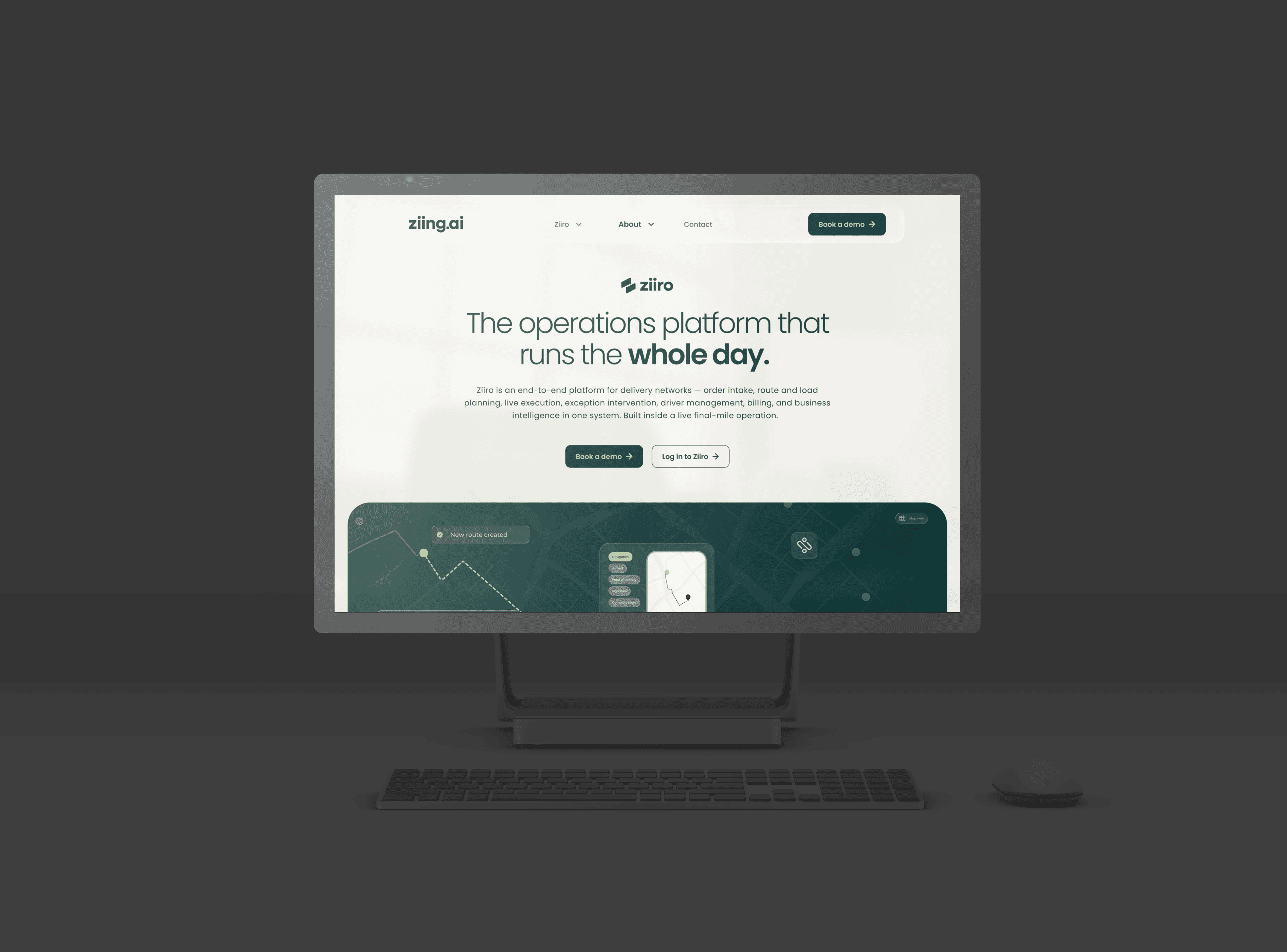
Ziiro
An intelligent, AI-driven platform redesigning logistics for speed, clarity, and simplicity.
Year:
2026
Timeframe:
1 month
Role:
Product designer
Category:
Web

Project overview
Ziiro (formerly Ziing.ai) is a 0-to-1 operational platform engineered to unify fragmented delivery networks. Built inside a live final-mile environment, it replaces the error-prone "duct-taped" software stacks typical of traditional logistics with a seamless, single-system loop. By automating data flow from order intake to settlement, Ziiro eliminates manual re-keying and surfaces real-time exception insights before bottlenecks occur. Due to NDA restrictions on this complex B2B platform, I cannot share the entire ecosystem of thousands of design files. Instead, this walkthrough examines a single key workflow redesign to showcase my end-to-end strategy, UX logic, and visual execution.

Problem
After two years of relying strictly on table views for route management, operational managers and service providers struggled to visualize route distribution, driver assignments, and live dispatch issues. The core challenge was designing a system that enables operators to effortlessly locate friction points, monitor real-time tasks, and manage exceptions with minimal manual intervention.
Initial Findings
To identify core operational bottlenecks, we conducted a group interview with 5 daily operational managers. Our research revealed three major friction points: High Manual Friction in Risk Assessment: Dispatchers rely on manual, multi-step filtering to identify delayed routes, completed deliveries, and specific exception codes
Lack of Real-Time Visibility: Operators are forced to make manual phone calls to drivers to locate vehicles and confirm on-the-ground issues.
Absence of Cascading Delay Alerts: The system lacks proactive notification mechanisms to warn managers when a single delayed step compromises downstream route schedules.

Phased Design Strategy: Speed to Insight
In time-critical logistics, seconds save delivery SLAs. We prioritized our research findings into a two-phase rollout to deliver immediate operational value while building toward a comprehensive visual system:
Phase 1: High-Density Data Visualization (Quick Wins)
Focused on transforming complex datasets into actionable dashboard metrics. Operational managers can instantly identify delayed routes, exception codes, and completion rates without manual filtering—creating a unified data layer shared across tabular, dashboard, and dispatch views.
Phase 2: Dynamic Spatial & Track Distribution
Introduced visual route mapping and live spatial tracking. This enables dispatchers to visualize driver distribution, monitor real-time progress, and proactively manage cascading delays on an interactive dispatch board.
Solution: Phase 1
To accelerate operational decision-making, we focused on surfacing five core metrics: Total Routes, Completed Routes, Ongoing Routes, Risk of Delay, and Status-Coded Exceptions. To ensure instant visual recognition, critical exceptions were assigned distinct color codes. Evaluating Two Architectural Paths: Dedicated Overview Dashboard: A centralized landing page with macro-level operational metrics. In-Context Summary Bar: Embedding live metric widgets directly at the top of the existing Routes view. Co-Design & Decision Logic: Through participatory co-design sessions with daily operational managers, we learned that users work exclusively inside the active Routes management page. Introducing a separate dashboard would add context-switching friction. We selected Approach 2 (In-Context Metrics), placing real-time operational indicators directly where dispatchers make high-frequency decisions.
Solution: Phase 2
Phase 2 Solution: Visual Tracking & Automated Alerting In Phase 2, we shifted from purely tabular monitoring to an integrated map view designed to bring real-time spatial awareness to daily dispatch workflows: Live Driver & Route Mapping: Surfaces real-time vehicle positions and route distributions to give operational managers an instant, complete picture of field activities. Automated Risk & Priority Reminders: Displays automated alerts for high-priority items—such as unassigned orders or cascading delays—ensuring immediate visibility before SLAs are missed. Direct In-Map Interventions: Empowers dispatchers to perform core route management and driver assignment directly within the map overlay, drastically reducing time-to-action.